

 0
0
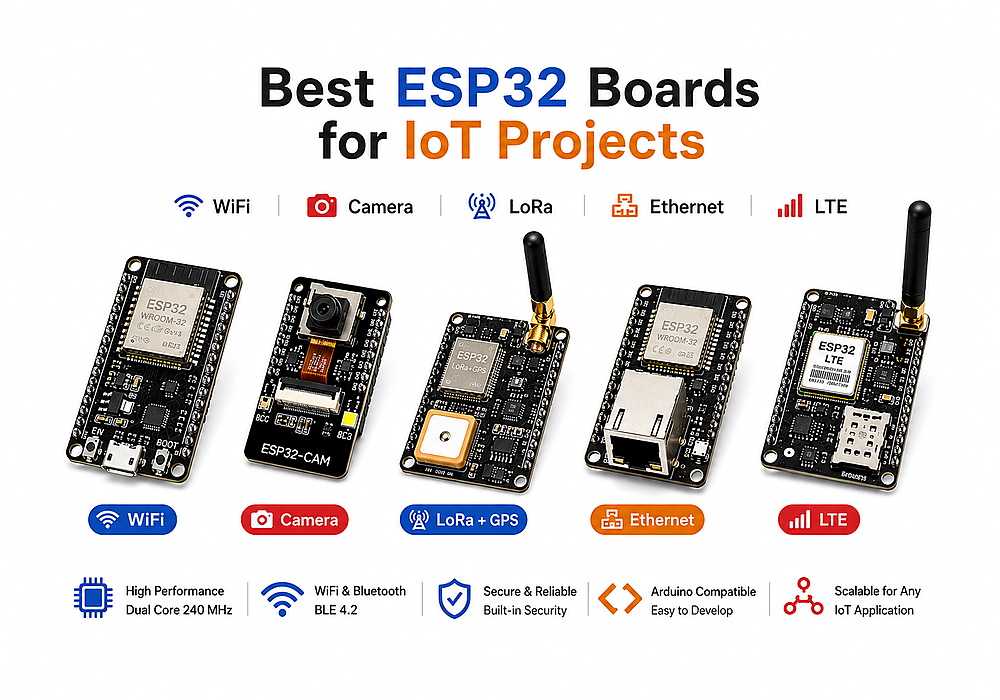
Choosing an ESP32 board looks simple at first. You search for “ESP32 board,” find dozens of low-cost development boards, and assume they all do roughly the same thing. But once your IoT project becomes more specific, the choice gets harder. A basic WiFi sensor, a camera module, a LoRa GPS tracker, an Ethernet-based controller and a cellular LTE device all have very different hardware needs.
That is why the best ESP32 board is not always the newest or most expensive one. It is the board that matches your project’s connectivity, power, sensor interface, size and deployment environment. For beginners, an ESP32 DevKit or ESP32-C3 board may be enough. For camera projects, an ESP32-CAM or ESP32-S3 CAM board is more suitable. For long-range outdoor sensors, an ESP32 LoRa GPS board can be a better fit than WiFi. For fixed industrial or building automation systems, Ethernet, PoE, CAN or RS485 support may matter more than board size.
This guide explains how to choose the best ESP32 boards for IoT projects, including WiFi, camera, LoRa, Ethernet and LTE options. Instead of listing boards only by chip name, we will compare them by real project needs.
1. Quick Answer: Which ESP32 Board Should You Choose?
If you are not sure where to start, choose the ESP32 board based on the project you want to build, not only the chip model. Most beginner mistakes happen because users buy a board first and only later realize they need a camera connector, external antenna, battery charging circuit, RS485 interface or LTE module.
| Project Type | Recommended ESP32 Board Type | Why It Fits |
|---|---|---|
| Basic WiFi IoT sensor | ESP32 DevKit / ESP32-WROOM | Low cost, easy to program and enough GPIO for most sensors. |
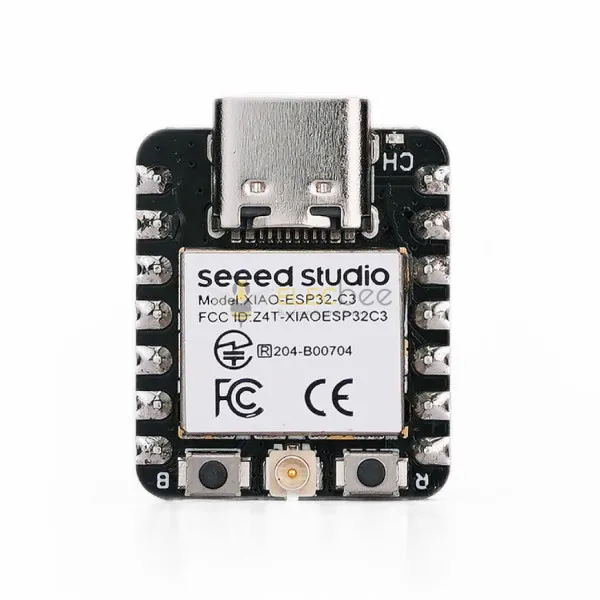
| Small smart device | ESP32-C3 / ESP32 SuperMini / XIAO ESP32-C3 | Compact size, WiFi and Bluetooth support for small IoT nodes. |
| Dual-band WiFi 6 IoT | XIAO ESP32-C5 | Supports both 2.4GHz and 5GHz WiFi 6 for compact connected devices. |
| Camera or remote monitoring | ESP32-CAM / ESP32-S3 CAM | Designed for image capture, wireless camera projects and simple vision tasks. |
| LoRa GPS tracking | ESP32 LoRa GPS board / T-Beam type board | Combines ESP32, LoRa, GPS and often battery support for long-range low-data projects. |
| Fixed installation | ESP32 Ethernet / PoE board | More stable than WiFi for fixed sensors, controllers and gateways. |
| Remote cellular IoT | ESP32 LTE / SIM board | Useful when WiFi is unavailable and data must be sent through a cellular network. |
For most beginners, a standard ESP32 DevKit is the safest starting point. For real IoT deployment, however, the right board depends on how the device will communicate, how it will be powered and what hardware must be connected.
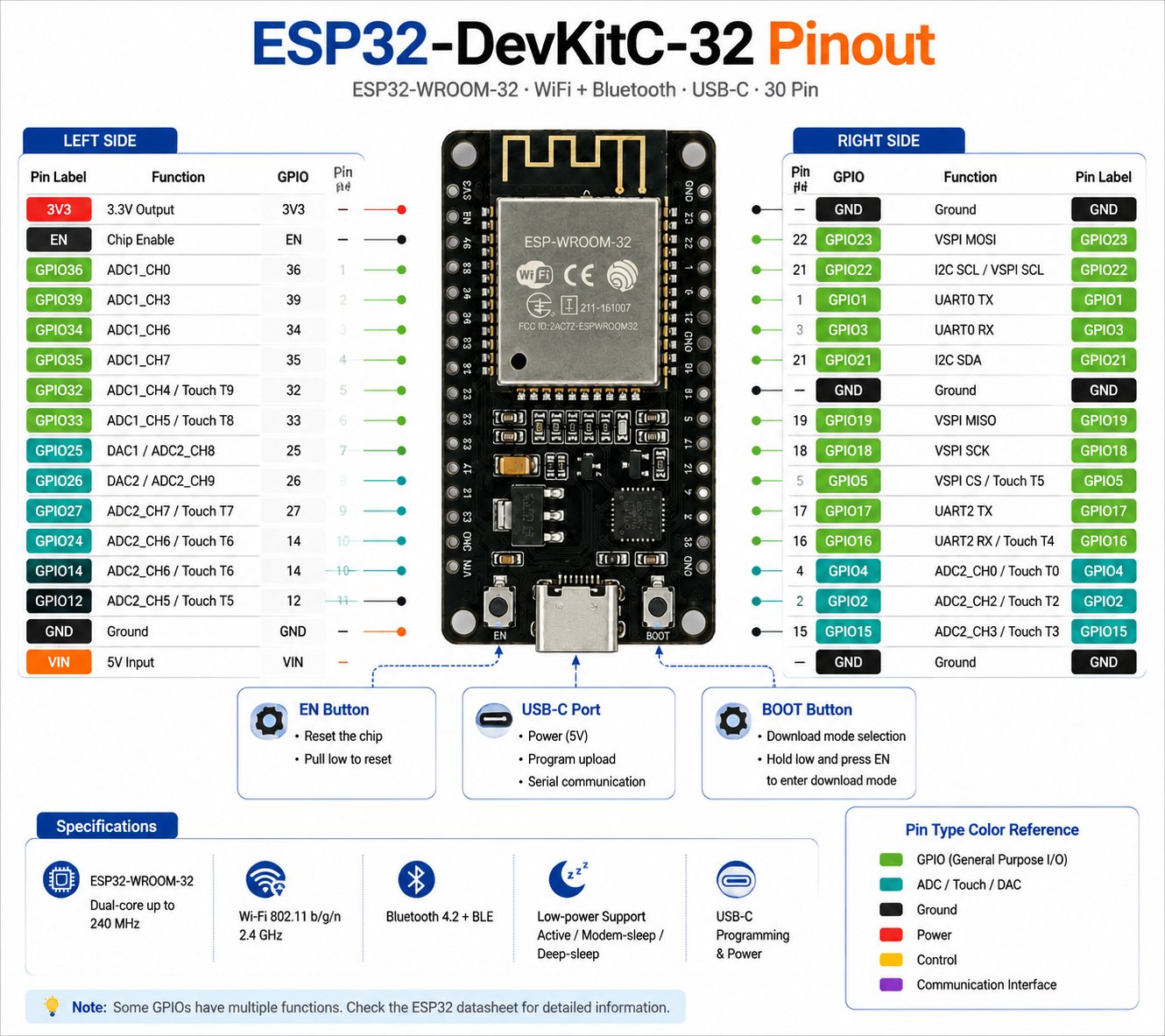
2. What Makes ESP32 Boards Popular for IoT Projects?
ESP32 boards are widely used in IoT projects because they combine wireless connectivity, flexible GPIO and a large developer ecosystem in a compact and affordable platform. A typical ESP32 board can connect to WiFi, communicate with Bluetooth devices, read sensors, control relays, drive displays and send data to a web server or home automation system.
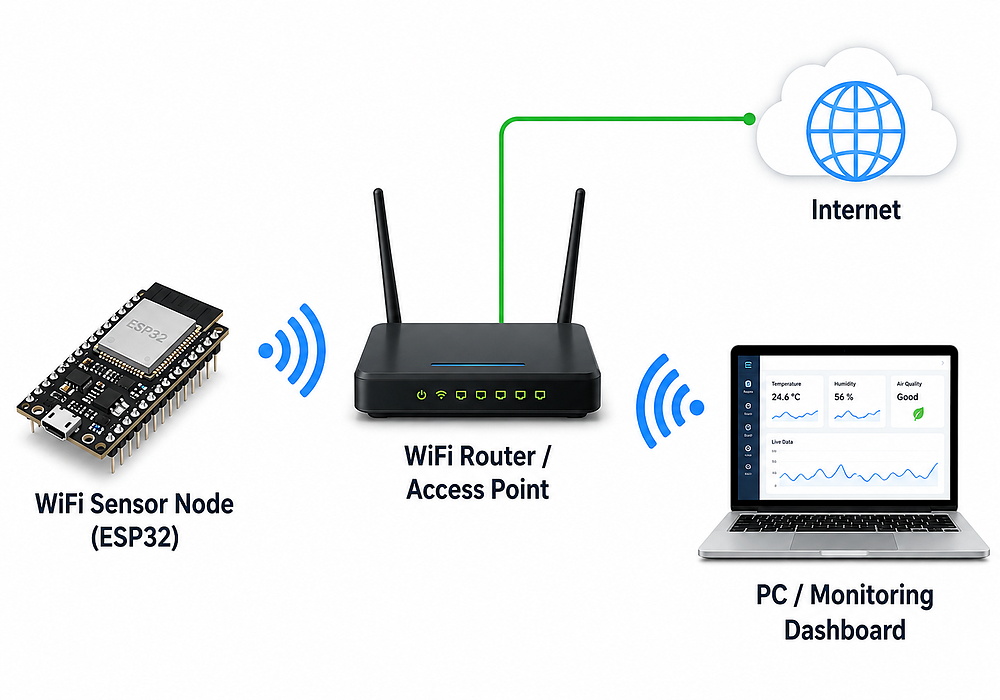
Built-in WiFi and Bluetooth for Connected Devices
The biggest reason many makers choose ESP32 is built-in wireless connectivity. For a temperature sensor, smart relay, air quality monitor, garage door monitor or small web server, WiFi support makes the ESP32 much easier to use than a microcontroller that requires an external wireless module.
Bluetooth and BLE are also useful for nearby device control, provisioning, portable gadgets and low-data communication. However, not every ESP32 family member supports the same Bluetooth features, so it is important to check whether your project needs classic Bluetooth, BLE or only WiFi.
GPIO, Sensors, Displays and Expansion Interfaces
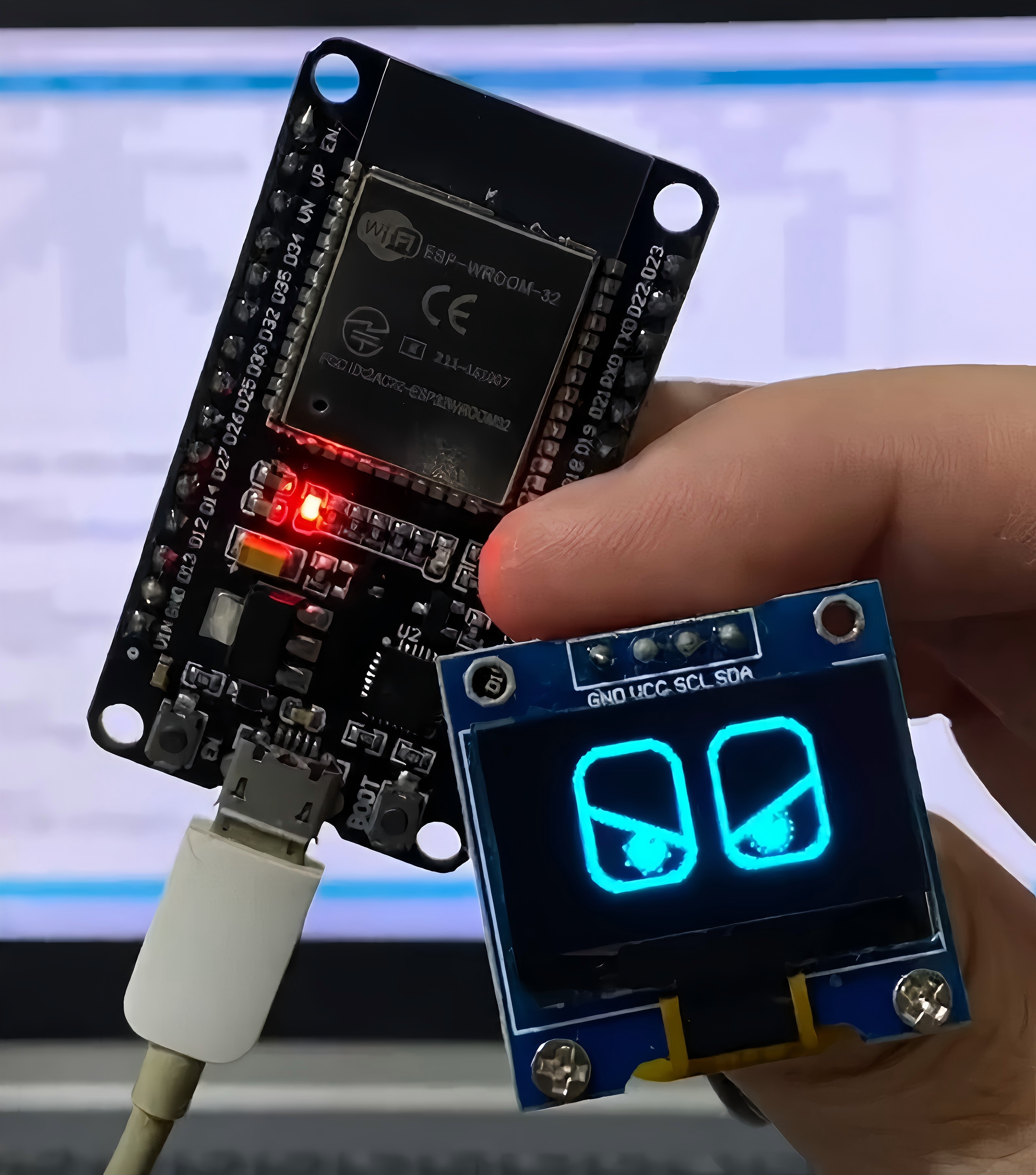
ESP32 boards can connect to many common modules through GPIO, I2C, SPI, UART, ADC and PWM. That makes them suitable for sensors, OLED displays, relay boards, IR transmitters, motor drivers, GPS modules and communication expansion boards.
If your project is only reading a few sensors, most ESP32 boards will work. But if you need a camera, LoRa, RS485, CAN bus, Ethernet or LTE modem, it is often easier to buy a board with those interfaces already integrated.
Software Ecosystem: Arduino IDE, MicroPython, ESP-IDF and ESPHome
The ESP32 ecosystem is strong because users can choose different software environments. Arduino IDE is beginner-friendly. MicroPython is useful for quick scripting. ESP-IDF offers deeper control for advanced developers. ESPHome is popular for Home Assistant and smart home projects.
For a first project, documentation and community examples can matter more than raw performance. A well-documented board can save hours of debugging, especially when dealing with pin maps, USB drivers, camera configuration or power management.
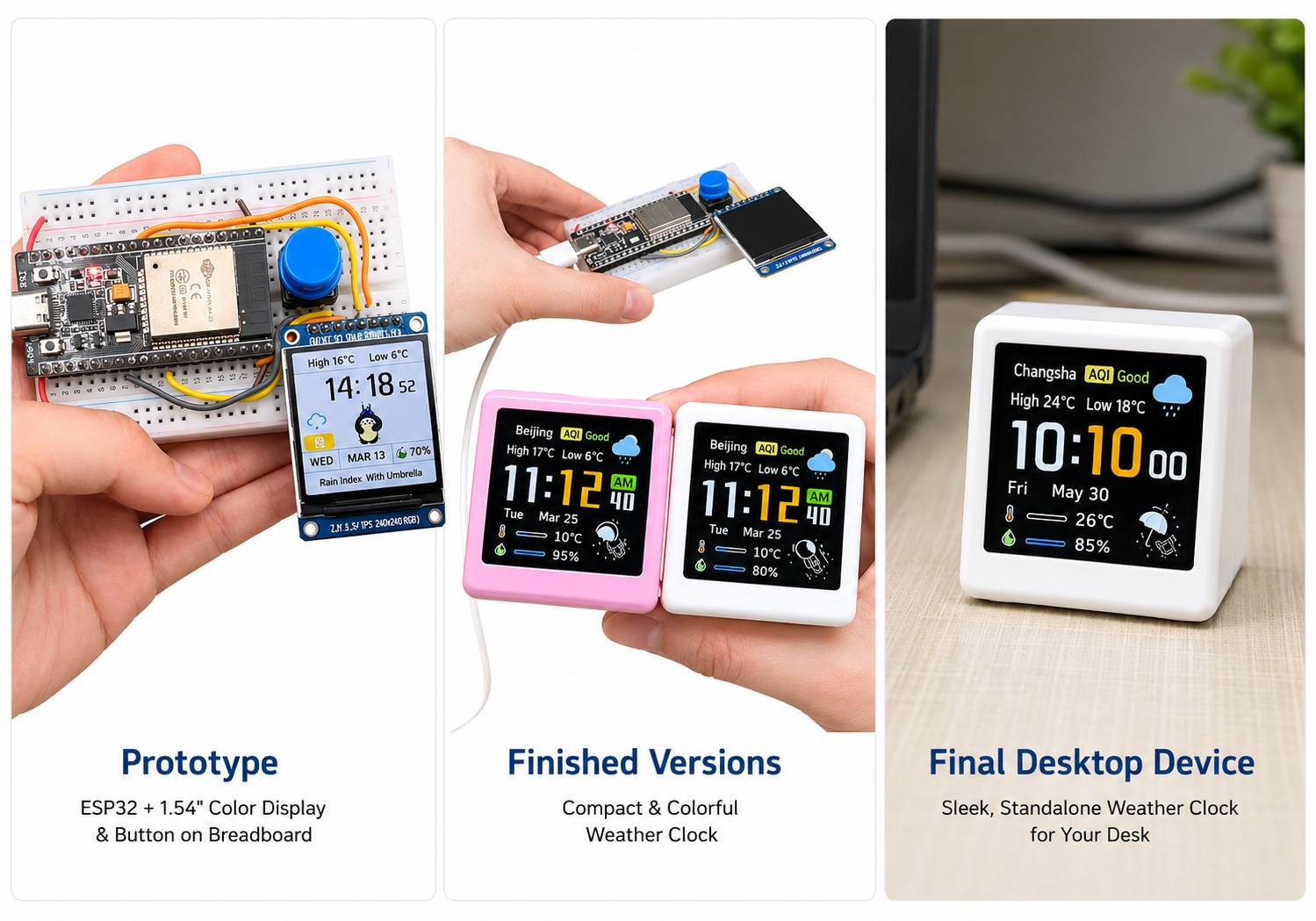
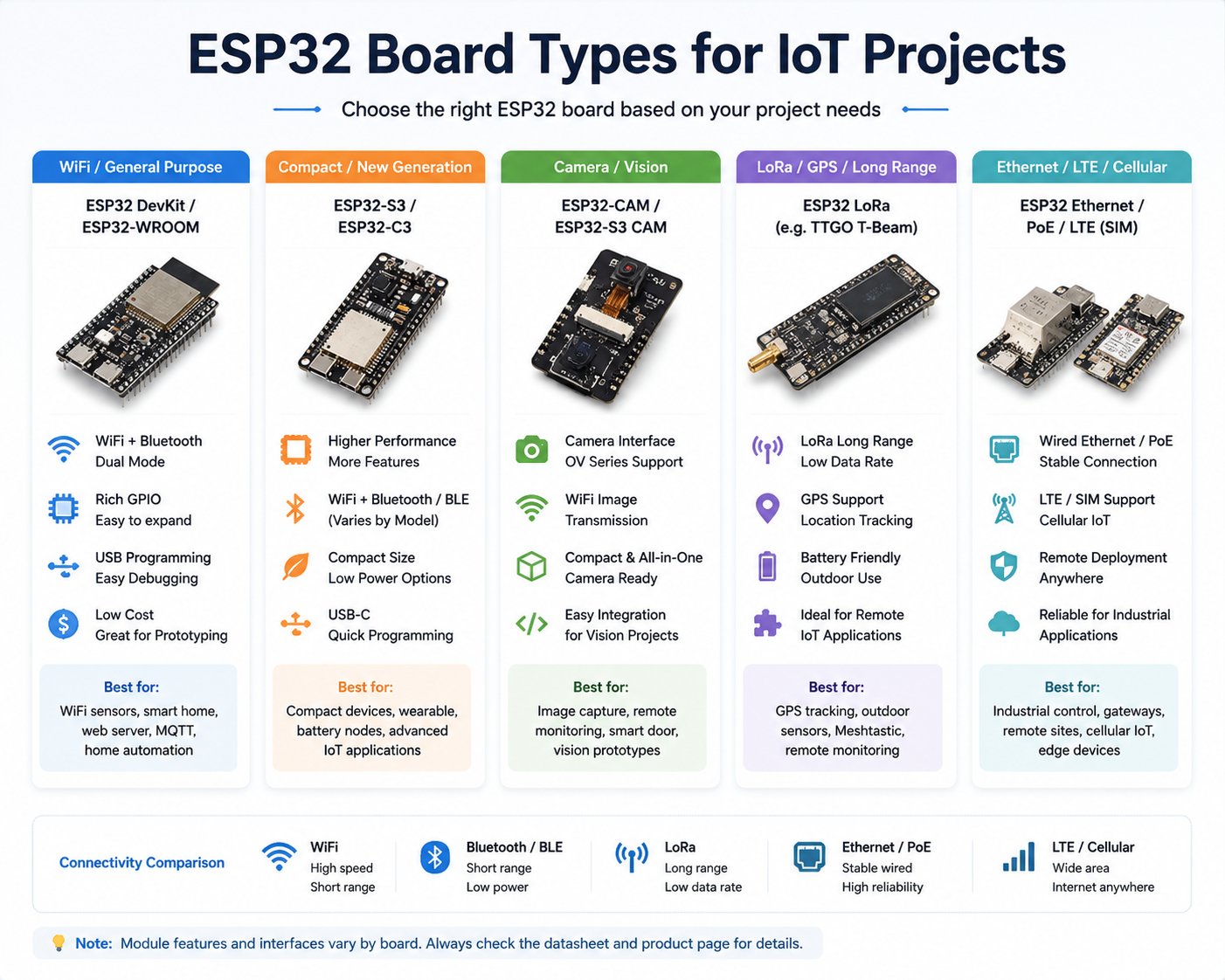
3. ESP32 Board Types Explained: WiFi, Camera, LoRa, Ethernet and LTE
There is no single “best ESP32 board” for every IoT project. The right choice depends on whether your project needs WiFi, camera, long-range radio, wired networking, cellular connectivity or industrial interfaces.
ESP32 DevKit / ESP32-WROOM for General WiFi Projects
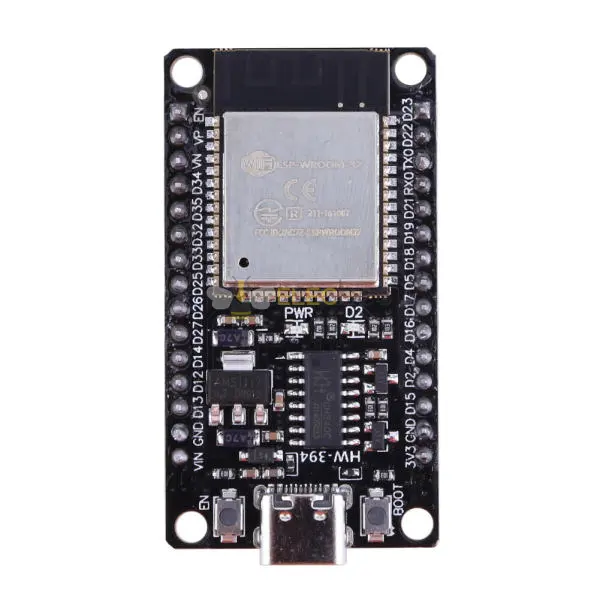
A standard ESP32 DevKit or ESP32-WROOM board is the best all-purpose option for beginners and general WiFi IoT projects. It is suitable for sensor nodes, smart switches, small web servers, MQTT devices, Bluetooth experiments and Home Assistant integrations.
Choose this type when your project needs:
- WiFi and Bluetooth connectivity
- Enough GPIO for sensors and relays
- USB programming and easy debugging
- Low-cost prototyping
- Arduino IDE, ESPHome or MicroPython support
A DevKit is not always the smallest or most power-efficient board, but it is usually the easiest way to start. It is also a good choice if you plan to test the circuit first and later design a custom PCB.
ESP32-C3, ESP32-C5, ESP32-C6 and ESP32-S3 for Compact or Newer IoT Devices
ESP32-C3 boards are popular for compact WiFi and Bluetooth projects. They are often used in small sensors, smart home nodes and space-limited designs. ESP32-S3 boards are a stronger option when you need more processing capability, USB features, camera support or more advanced applications.
If you only need a small wireless node, an ESP32-C3 board can be enough. If you plan to add a display, camera, more memory or heavier processing, ESP32-S3 may be a better choice.
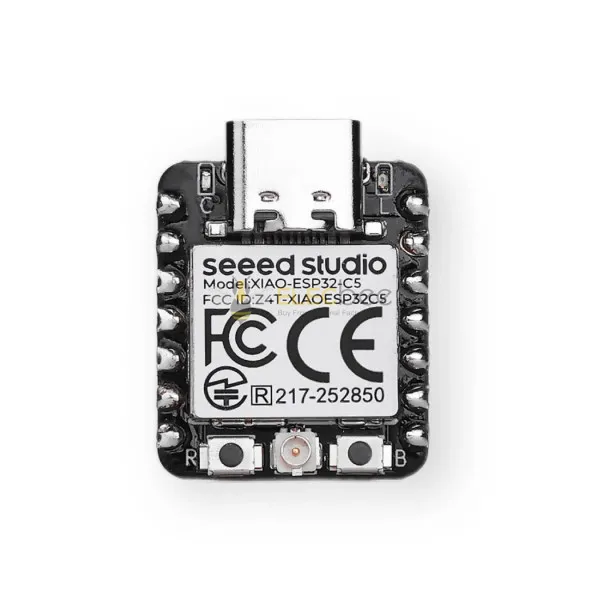
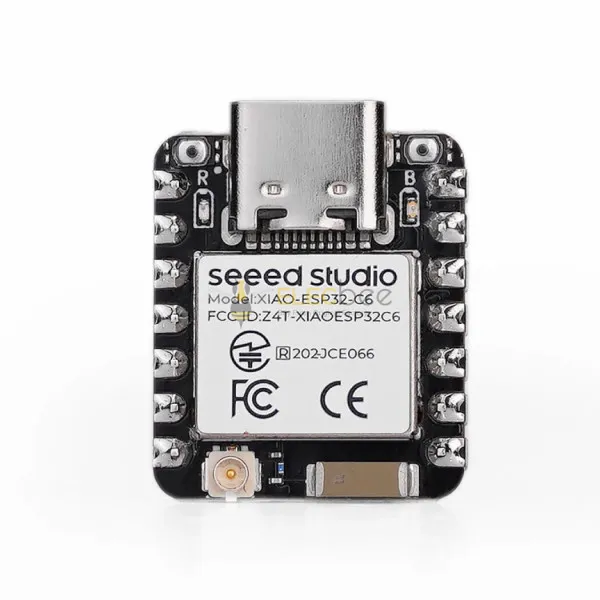
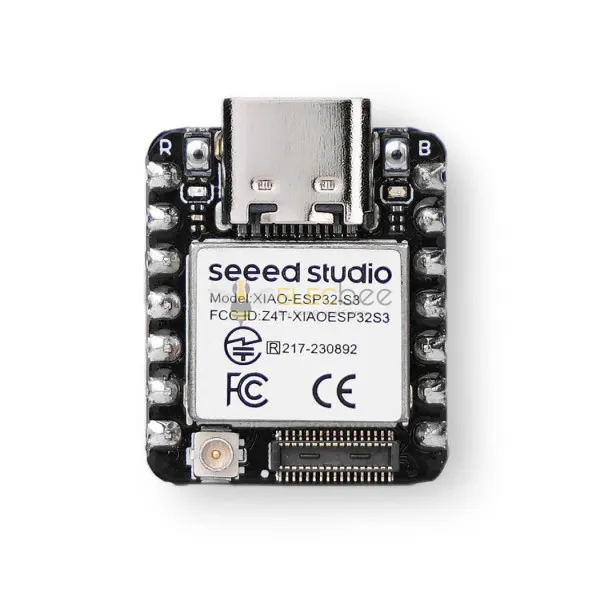
For space-constrained IoT projects, XIAO ESP32 boards combine popular ESP32 chips with a compact, thumb-sized form factor. Choose the XIAO ESP32-C3 for basic WiFi and BLE sensors, the XIAO ESP32-S3 for camera and higher-performance applications, the XIAO ESP32-C6 for WiFi 6, Zigbee, Thread and Matter projects, or the XIAO ESP32-C5 when dual-band 2.4GHz and 5GHz WiFi 6 connectivity is required.
For small finished projects, remember that the board is not the only size factor. Motors, sensors, battery, connectors, antenna and enclosure may take more space than the ESP32 board itself. Always check the full hardware layout before choosing the smallest board.
ESP32-CAM and ESP32-S3 CAM for Camera Projects
For image capture, remote monitoring and simple vision projects, ESP32-CAM boards are usually more practical than adding a camera to a normal ESP32 DevKit. An ESP32-CAM board already includes the camera interface and is commonly used for wireless image transmission, smart door viewers, basic surveillance, time-lapse cameras and embedded vision prototypes.
However, an ESP32-CAM is not a magic AI accelerator. It is still an ESP32-based board with a camera interface. The advantage is convenience: it gives you a compact, low-cost way to connect a camera and send images wirelessly.
Choose an ESP32-CAM or ESP32-S3 CAM when your project needs:
- Image capture or remote monitoring
- Small camera module integration
- WiFi image transmission
- Simple machine vision experiments
- A compact camera-ready board
Pay attention to power supply quality. Camera boards may become unstable if the power source cannot provide enough current during WiFi transmission or image capture.
LoRa and GPS ESP32 Boards for Long-Range Tracking
When the device needs long-range, low-bandwidth communication, LoRa can be a better fit than WiFi. ESP32 LoRa boards are commonly used for GPS trackers, outdoor sensors, Meshtastic nodes, environmental monitoring and remote status reporting.
Boards such as T-Beam style ESP32 LoRa GPS boards are attractive because they combine multiple functions: ESP32, LoRa radio, GPS module, antenna connector and often battery support. This reduces wiring complexity and makes them more suitable for field testing.
Choose an ESP32 LoRa GPS board when your project needs:
- Longer range than normal WiFi
- Small data packets
- GPS location tracking
- Outdoor or mobile deployment
- Battery-powered operation with careful sleep strategy
LoRa is not designed for high-bandwidth data such as video. It is best for small messages, sensor readings, GPS coordinates and periodic status updates.
Ethernet and PoE ESP32 Boards for Stable Fixed Installations
WiFi is convenient, but it is not always the best choice for fixed IoT installations. If your device is installed in a cabinet, factory, building, server room or smart home control box, Ethernet can provide a more stable connection.
An ESP32 Ethernet or PoE board is useful when you want fewer wireless issues, centralized power and a more reliable network connection. PoE can be especially helpful because a single cable can provide both data and power, depending on the board design and network setup.
Choose an ESP32 Ethernet or PoE board when your project needs:
- Stable wired networking
- Fixed installation
- Reduced WiFi interference
- Gateway or controller applications
- Power and data through one cable
LTE / SIM ESP32 Boards for Cellular IoT
LTE ESP32 boards are designed for projects where WiFi is not available. They are useful for remote sensors, GPS trackers, agricultural devices, outdoor equipment, vending machines, mobile assets and industrial monitoring.
Cellular connectivity is powerful, but it is rarely the cheapest option. The module, antenna, SIM card, data plan, certification and regional band support all affect the final cost. Before choosing an ESP32 LTE board, ask whether the device truly needs direct cellular access or whether WiFi, LoRa or a gateway can solve the problem.
Choose an ESP32 LTE board when your project needs:
- Internet access without WiFi
- Remote deployment across different locations
- GPS plus cellular reporting
- Periodic small data uploads
- Independent connection without a local gateway
4. How to Choose an ESP32 Board for Your Project
The easiest way to choose an ESP32 board is to start from requirements, not from the chip name. Follow these four steps before buying.
Step 1: Define Connectivity Requirements
First, decide how the device will communicate. If it will connect to a home router, WiFi is enough. If it needs short-range phone control, Bluetooth or BLE may be important. If it needs long-range outdoor communication, consider LoRa. If it is installed permanently, Ethernet or PoE may be better. If it has no local network, LTE may be required.
- Use WiFi for home automation, web servers and local IoT devices.
- Use BLE for nearby control, provisioning and portable devices.
- Use LoRa for long-range, low-data sensor networks.
- Use Ethernet or PoE for reliable fixed installations.
- Use LTE when the device must work without WiFi or a gateway.
Step 2: Check Power Source and Battery Life
Battery-powered ESP32 projects need careful planning. WiFi can consume significant power during connection and transmission. If the device must run for weeks or months, deep sleep, wake intervals, sensor power control and radio on-time become critical.
For solar or battery projects, ask:
- How often does the device need to send data?
- Can it sleep most of the time?
- Does it need WiFi always on?
- Can LoRa or BLE reduce power consumption?
- Does the board have efficient power management?
If the device only sends data occasionally, ESP32 can work well with a sleep strategy. If it must keep WiFi active constantly, power consumption may become a problem.
Step 3: Match Interfaces to Sensors and Modules
Next, check the hardware interface. A basic ESP32 board may have enough GPIO for simple sensors, but industrial sensors, cameras and communication modules may require specific interfaces.
- Use I2C for many environmental sensors and displays.
- Use SPI for faster displays, storage or radio modules.
- Use UART for GPS, serial modules and some modems.
- Use RS485 or CAN for industrial sensors and controllers.
- Use camera-ready boards for image projects.
If your sensor uses RS485 or CAN bus, it is usually easier to choose an ESP32 board or shield with that interface already included rather than wiring everything from separate modules.
Step 4: Choose Between Prototype Board and Production Design
For hobby projects and proof-of-concept testing, a ready-made ESP32 development board is usually the best choice. It saves time and reduces hardware risk. For a product that may be sold later, a custom PCB may eventually be needed to reduce cost, improve size, improve reliability and integrate only the required components.
A practical workflow is:
- Start with a ready-made ESP32 development board.
- Validate sensors, power and communication method.
- Test real-world range, current consumption and stability.
- Move to a custom PCB only after requirements are stable.
5. ESP32 Board Comparison Table
The table below summarizes the most common ESP32 board choices for IoT projects.
| Board Type | Best For | Main Advantages | Limitations |
|---|---|---|---|
| ESP32 DevKit / WROOM | General WiFi IoT | Affordable, well supported, easy to prototype | Not optimized for every low-power or compact design |
| ESP32-C3 | Small WiFi/BLE devices | Compact and suitable for simple connected devices | May not be ideal for heavy processing or many peripherals |
| ESP32-S3 | More advanced IoT, camera and display projects | More capable option for larger projects | May cost more than basic ESP32 boards |
| XIAO ESP32-C5 / XIAO ESP32-C6 | Compact WiFi 6, smart home and multiprotocol IoT devices | C5 adds 2.4GHz/5GHz dual-band WiFi 6; C6 supports Zigbee, Thread and Matter | Choose according to wireless band and protocol requirements |
| ESP32-CAM / S3 CAM | Camera and image capture | Camera-ready, compact and widely used | Needs stable power and careful configuration |
| ESP32 LoRa GPS | Tracking and long-range sensors | Long range, GPS support and low-data communication | Not suitable for high-bandwidth data |
| ESP32 Ethernet / PoE | Fixed sensors and controllers | Reliable wired connection | Requires network cable and suitable installation |
| ESP32 LTE / SIM | Remote cellular IoT | Works without local WiFi | Higher cost, SIM plan and regional band considerations |
6. Common Mistakes When Choosing ESP32 Boards
Mistake 1: Ignoring Power Consumption in Battery Projects
Many users choose ESP32 because it has WiFi, then later discover that always-on WiFi is not ideal for small battery-powered devices. This does not mean ESP32 cannot be used with batteries. It means the design must sleep most of the time, wake only when needed and minimize radio transmission time.
For battery projects, avoid keeping WiFi connected continuously unless you have a large enough battery or external power source.
Mistake 2: Choosing LTE When LoRa or a Gateway Is Enough
LTE is useful, but it adds cost and complexity. A cellular IoT board may require antennas, SIM cards, regional band checks and data plans. If your device only sends small packets from a local area, LoRa plus a gateway may be more efficient. If the device is installed in a building, Ethernet or WiFi may be simpler.
Mistake 3: Buying the Smallest Board Before Checking the Full Hardware
A tiny ESP32 board is attractive, but the final device also needs power, wiring, sensors, antenna, connectors and enclosure space. In small robotics or wearable projects, motors and batteries often become the real size problem, not the ESP32 chip itself.
Mistake 4: Assuming ESP32-CAM Has Special AI Hardware
ESP32-CAM is popular because it is camera-ready and affordable, not because it has a dedicated AI accelerator. It is useful for image capture and simple vision projects, but advanced image processing may need more powerful hardware or cloud-side processing.
Mistake 5: Forgetting Antenna and Connector Requirements
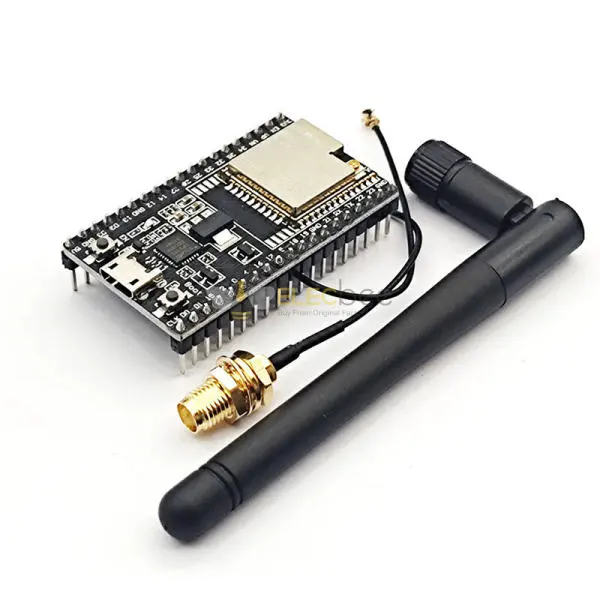
For long-range WiFi, LoRa, LTE or GPS projects, antenna design matters. A board with an external antenna connector can be useful when the device is installed inside an enclosure or used in a weak signal area. Always check whether the board uses onboard antenna, IPEX/U.FL, SMA or another antenna connection.
7. FAQ: ESP32 Boards for IoT Projects
Which ESP32 board is best for beginners?
A basic ESP32 DevKit or ESP32-WROOM development board is usually the best starting point. It is affordable, widely documented and suitable for WiFi sensors, relays, MQTT, ESPHome and Arduino IDE projects. If you need a smaller board, ESP32-C3 can also be a good beginner option.
Is ESP32 good for battery-powered IoT projects?
Yes, but only if the power strategy is designed carefully. ESP32 can work in battery-powered projects when it sleeps most of the time and wakes only to read sensors or send data. If WiFi must stay active continuously, battery life may be poor. For long-range low-data applications, LoRa or BLE may be more power-friendly than frequent WiFi transmission.
Should I choose ESP32-CAM or ESP32-S3 CAM?
Choose ESP32-CAM for low-cost camera experiments, simple remote monitoring and basic image capture. Choose ESP32-S3 CAM when you want a newer and more capable platform for camera, display or more advanced embedded vision projects. In both cases, use a stable power supply.
Is LoRa better than WiFi for ESP32 IoT projects?
LoRa is better for long-range, low-bandwidth communication. WiFi is better when the device is near a router and needs higher data speed. For GPS trackers, outdoor sensors and remote status updates, an ESP32 LoRa GPS board can be more suitable than a standard WiFi board.
When should I use an ESP32 LTE board?
Use an ESP32 LTE board when the device must send data without local WiFi or a nearby gateway. It is suitable for remote monitoring, mobile assets, outdoor equipment and geographically distributed devices. Before choosing LTE, check module bands, antenna requirements, SIM cost and power consumption.
Can ESP32 be used with RS485 or CAN bus sensors?
Yes. ESP32 can be used with RS485 or CAN bus sensors when the correct transceiver or integrated board is used. For industrial sensors, a board with built-in RS485 or CAN support is usually easier and cleaner than wiring separate breakout modules.
Do I need ESP32-S3, or is a normal ESP32 enough?
For simple WiFi sensors, relays and web server projects, a normal ESP32 DevKit is often enough. Choose ESP32-S3 when you need more advanced features, more processing headroom, camera support, USB features or a more capable development platform.
Conclusion: Choose the ESP32 Board by Project, Not by Name
The best ESP32 board for IoT projects depends on what you are building. A standard ESP32 DevKit is ideal for general WiFi sensors and beginner projects. ESP32-C3 is useful for compact wireless devices. ESP32-S3 and ESP32-S3 CAM are better for more advanced camera or display projects. ESP32 LoRa GPS boards are suitable for long-range tracking and remote sensors. Ethernet and PoE boards are better for fixed installations, while LTE boards are useful when WiFi is not available.
Before buying, define five things: connectivity, power source, sensor interface, size and deployment environment. Once those are clear, choosing the right ESP32 board becomes much easier.
Choose the Right ESP32 Board for Your IoT Project
From basic WiFi prototypes to camera modules, LoRa GPS trackers, Ethernet controllers and LTE remote sensors, our ESP32 IoT Project Boards page helps you quickly match each project type with suitable ESP32 board options.
Related Products
- XIAO ESP32-C5 & XIAO ESP32-C6 – compact WiFi 6 boards for dual-band wireless, Zigbee, Thread, Matter, and smart home IoT projects.
- ESP32 IoT Project Boards – choose ESP32 boards for WiFi, camera, LoRa, Ethernet, and LTE IoT projects.
- ESP Series Boards – browse ESP32, ESP8266, LoRa, camera, and wireless development boards for prototyping.
- TTGO T-Beam ESP32 LoRa Development Boards – ESP32 LoRa boards for GPS tracking, Meshtastic nodes, long-range sensors, and outdoor IoT projects.
- RF Antennas – antennas for WiFi, LoRa, LTE, GPS, and Bluetooth signal improvement in ESP32 IoT projects.
- IoT Antenna Solutions – antenna solutions for smart home devices, wireless sensors, and connected IoT systems.
- RF Connectors & Adapters – SMA, IPEX/U.FL, and RF adapters for external antenna connections on ESP32 wireless boards.
- USB Cables & Connectors – USB cables and connectors for ESP32 programming, debugging, and power input.