0

ESP32-C3, ESP32-S3, and ESP32-C6 are not a low-to-high upgrade line. Each targets a different set of hardware interfaces and wireless protocols:
- Choose ESP32-C3 for everyday 2.4 GHz Wi-Fi and Bluetooth LE sensor nodes, switches, and serial-logged controllers that run within internal SRAM and only use USB for flashing and serial console output.
- Choose ESP32-S3 when your build needs native programmable USB (such as emulating a USB HID keyboard or mouse), external PSRAM for display buffers or camera capture, or dual application cores.
- Choose ESP32-C6 when your project requires native IEEE 802.15.4 connectivity for Thread or Zigbee, Matter over Thread, or 2.4 GHz Wi-Fi 6 features, without needing external PSRAM or programmable USB OTG.
If you are still weighing broader hardware options such as boards with onboard LoRa transceivers, Ethernet ports, or cellular modems, see our general ESP32 board selection guide.
On this page
Core Specifications That Change Your Selection
The table below summarizes the core architectural differences from the official Espressif datasheets for the ESP32-C3, ESP32-S3, and ESP32-C6.
| Feature | ESP32-C3 | ESP32-S3 | ESP32-C6 |
|---|---|---|---|
| Application CPU | Single-core 32-bit RISC-V, up to 160 MHz | Dual-core 32-bit Xtensa LX7, up to 240 MHz | Single 32-bit HP RISC-V core, up to 160 MHz (plus 20 MHz LP RISC-V core) |
| On-Chip SRAM | 400 KB | 512 KB | 512 KB HP SRAM (plus LP memory) |
| External PSRAM | Not supported | Supported (variant-dependent, Quad or Octal SPI) | Not supported |
| Wi-Fi | 2.4 GHz 802.11b/g/n (Wi-Fi 4) | 2.4 GHz 802.11b/g/n (Wi-Fi 4) | 2.4 GHz 802.11ax (Wi-Fi 6) + 802.11b/g/n |
| IEEE 802.15.4 | None | None | Thread 1.3 and Zigbee 3.0 |
| Native USB | Fixed-function USB Serial/JTAG | Fixed-function USB Serial/JTAG + Programmable USB 2.0 Full-Speed OTG | Fixed-function USB Serial/JTAG |
CPU Structure and Usable Memory
The ESP32-S3 provides two symmetric 240 MHz Xtensa LX7 application cores along with vector instructions for signal processing and machine learning workloads. Dual application cores are useful when a project runs parallel tasks, though actual responsiveness still depends on how your firmware and RTOS tasks are written. By contrast, when a board description lists the ESP32-C6 as having dual RISC-V processors, those cores are asymmetric: one high-performance (HP) core up to 160 MHz runs your main application, while a separate low-power (LP) core up to 20 MHz handles lightweight background monitoring and sleep tasks.
The 400 KB SRAM figure on the C3 and 512 KB on the S3 and C6 describe hardware capacity rather than free heap dedicated to user code. Once the FreeRTOS kernel and active Wi-Fi, Bluetooth LE, or 802.15.4 stacks allocate their runtime buffers, the remaining heap for application variables is considerably smaller.
USB Capabilities: Serial Console vs. Programmable USB OTG
A USB Type-C connector on a development board does not automatically mean the board can act as a USB keyboard, mouse, MIDI instrument, or mass storage drive. What the port can do depends on the USB controller inside the chip.
As documented in Espressif's ESP32-C3 USB Serial/JTAG Console guide and the ESP32-C6 datasheet, both the ESP32-C3 and ESP32-C6 integrate a fixed-function USB Serial/JTAG controller in hardware. It provides a CDC-ACM serial port for console logs and firmware flashing, plus a JTAG debug interface, without an external USB-to-UART bridge chip. Because this controller is hardwired in silicon for serial and debug functions, it cannot be reconfigured into a USB Human Interface Device (HID), Mass Storage Class (MSC), or audio device.
Among these three chips, the ESP32-S3 is the one that includes a native programmable USB 2.0 Full-Speed OTG controller alongside its USB Serial/JTAG block, as detailed in the ESP32-S3 datasheet. With an appropriate USB device stack in ESP-IDF or Arduino, the ESP32-S3 can enumerate as a custom USB HID keyboard, mouse, MIDI controller, or composite device.
Using the ESP32-S3 in USB Host mode to read a USB peripheral involves additional conditions beyond the chip itself. Your firmware needs a compatible USB host stack and class driver for that specific peripheral, and the development board must route the OTG data pins properly and supply 5 V VBUS power to the attached device.

A serial connection carries data to a terminal application. USB HID firmware lets the S3 identify itself to the computer as a keyboard.
Wireless Protocols: 2.4 GHz Wi-Fi 6, 802.15.4, Matter, and Bluetooth
Does ESP32-C6 Support 5 GHz Wi-Fi?
No. ESP32-C3, ESP32-S3, and ESP32-C6 all operate in the 2.4 GHz band. According to the ESP32-C6 datasheet, its IEEE 802.11ax (Wi-Fi 6) radio works in 2.4 GHz alongside legacy 802.11b/g/n networks. For IoT nodes, its notable addition is Target Wake Time (TWT), which lets the chip negotiate scheduled wake intervals when paired with a compatible Wi-Fi 6 access point and matching firmware configuration.
Do You Need ESP32-C6 to Build a Matter Device?
Matter is an application-layer protocol that runs over IP networks rather than a single radio type. According to Espressif's SDK for Matter documentation:
- ESP32-C3, ESP32-S3, and ESP32-C6 can all build Matter-over-Wi-Fi devices, using Bluetooth LE for initial commissioning and 2.4 GHz Wi-Fi for normal communication.
- Among the three, ESP32-C6 adds an integrated IEEE 802.15.4 radio, enabling Matter-over-Thread end devices as well as native Zigbee 3.0 nodes.
How Thread and Zigbee Differ in Practice
Although Thread and Zigbee share the 802.15.4 radio on the ESP32-C6, they connect to different network infrastructure:
- A Zigbee node joins a Zigbee mesh managed by a Zigbee coordinator; Zigbee support alone does not make a device compatible with Matter.
- A Matter-over-Thread device communicates over an IPv6 Thread mesh and requires a Thread Border Router to route IPv6 traffic between the Thread network and your home Wi-Fi or Ethernet network. While some multi-protocol smart-home hubs include border-router hardware, Zigbee hub functionality by itself does not provide a Thread Border Router.
- Sharing one 2.4 GHz antenna across Wi-Fi, BLE, and 802.15.4 involves radio coexistence and memory trade-offs, and buying a board with Matter-capable silicon means you can write or flash Matter firmware; it does not mean the board ships pre-configured or certified as a consumer smart-home product.

Both paths require Matter firmware. The Thread border router and Matter controller may be part of the same smart-home hub.
Bluetooth LE vs. Bluetooth Classic
All three chips support Bluetooth Low Energy (BLE) and Bluetooth Mesh, and none of the three support Bluetooth Classic (BR/EDR). Projects that previously used classic Bluetooth Serial Port Profile (SPP) for simple data transfer may be redesigned around BLE GATT services, provided the peer device and application support the new protocol. However, projects that require classic Bluetooth audio streaming (A2DP) need hardware with Bluetooth Classic support, such as an original dual-mode ESP32 board.
Memory Architecture, PSRAM, and Camera Workloads
Moving from basic sensor telemetry to driving a color display, buffering audio, or capturing camera frames shifts the bottleneck to runtime memory.
- Flash memory (such as 4 MB or 8 MB) is non-volatile storage for program code, file systems, and static read-only assets. It cannot act as fast read/write working memory for dynamic framebuffers.
- On-chip SRAM (400 KB on C3; 512 KB on S3 and C6) handles the call stack, RTOS tasks, wireless buffers, and general application state.
- External PSRAM adds megabytes of SPI-connected read/write RAM to the CPU address space on supported chips.
Even a single uncompressed 320 × 240 16-bit RGB565 display buffer requires 320 × 240 × 2 = 153,600 bytes (150 KiB) of contiguous RAM. Buffering camera frames, decoding images, or holding larger UI canvases alongside an active Wi-Fi or BLE stack quickly exhausts internal SRAM. Because neither ESP32-C3 nor ESP32-C6 supports external PSRAM or a dedicated parallel camera interface, among these three chips an ESP32-S3 board with sufficient PSRAM is the stronger candidate. You should still verify memory bandwidth, display or camera interface pins, and library support for your target frame rate.
When selecting an ESP32-S3 board for memory-intensive tasks, check two board-level details:
- PSRAM Presence, Size, and SPI Mode: Not every ESP32-S3 chip variant or board includes PSRAM. Verify whether the board populates PSRAM, how much it provides, and whether your IDE must be set to Quad SPI or Octal SPI PSRAM mode.
- Camera Interface vs. Included Camera Hardware: While the ESP32-S3 silicon includes a DVP camera interface and LCD controller, many compact S3 boards do not expose the camera pins or include a camera module. Confirm whether the product is a base MCU board or a camera kit.
Comparing Real Boards in the Same Footprint: XIAO ESP32-C3, S3, and C6
A chip name does not lock down the board layout. ESP32-C3 boards such as the SuperMini and Seeed Studio XIAO differ in pinout, antenna hardware, and power circuitry.
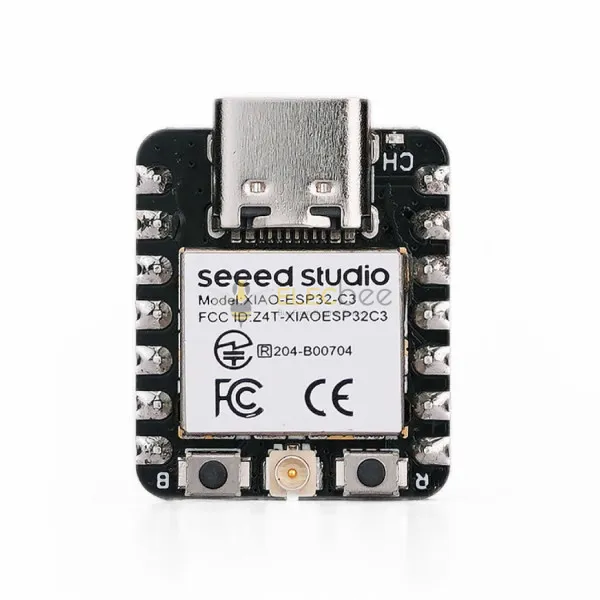
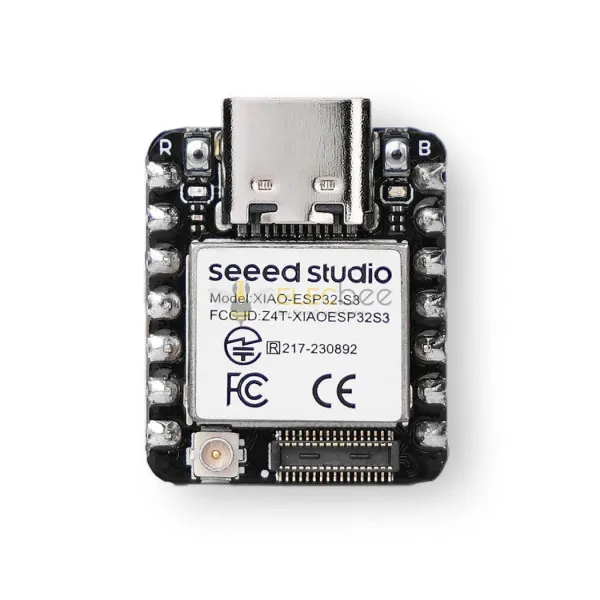
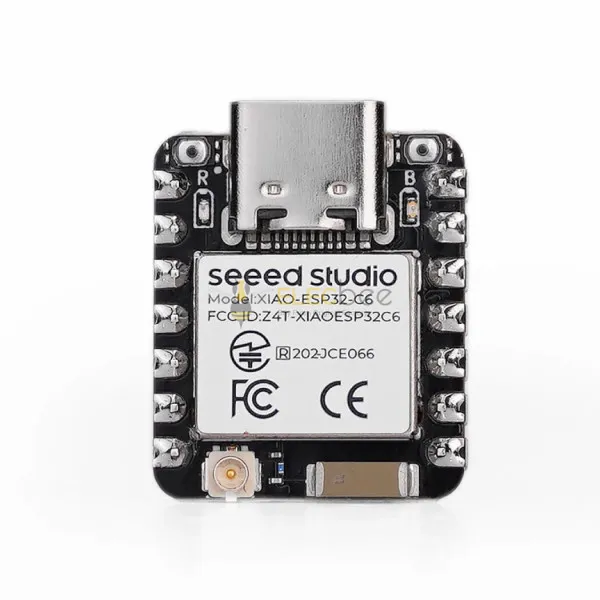
Looking at three boards that share the same 21 × 17.8 mm thumb-sized footprint shows how the C3, S3, and C6 differ at the board level. All three pre-soldered Seeed Studio XIAO boards support 3.7 V lithium battery input and charging. They are sold on Elecbee and documented in the official Seeed Studio guides for XIAO ESP32C3, XIAO ESP32-S3, and XIAO ESP32C6:

Pre-soldered · EB-XIAO-ESP32C3
XIAO ESP32-C3
This version has 4 MB Flash and a U.FL external antenna connector. It fits compact 2.4 GHz Wi-Fi and BLE sensor nodes, serial bridges, and low-duty-cycle loggers that work comfortably within internal SRAM. Because RF output goes to the U.FL receptacle rather than a built-in PCB antenna, connect a compatible external 2.4 GHz antenna for wireless operation and check the product page for included accessories.
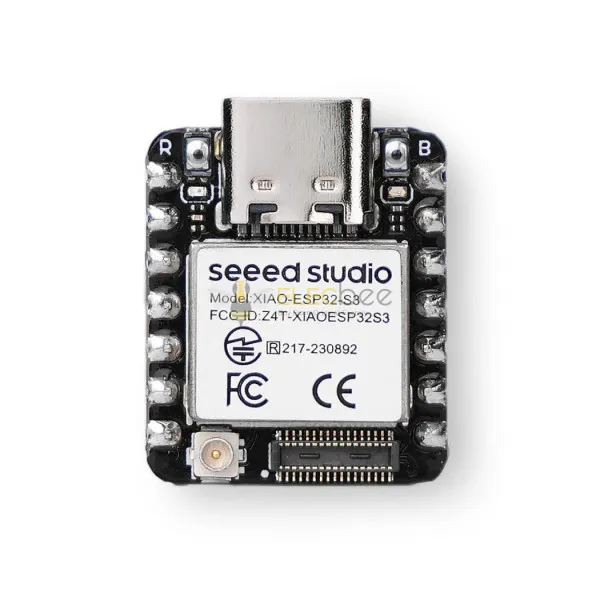
Pre-soldered · EB-XIAO-ESP32S3
XIAO ESP32-S3 base board
This version has 8 MB PSRAM, 8 MB Flash and a U.FL external antenna connection. It is the standard base board. It does not include the detachable camera expansion board, digital microphone, or SD card slot found on the XIAO ESP32-S3 Sense kit.

Pre-soldered · EB-XIAO-ESP32C6
XIAO ESP32-C6
This 4 MB Flash board is a candidate for Thread and Zigbee projects. Unlike the C3 and S3 XIAO boards, it includes both an onboard ceramic antenna and a U.FL connector; selecting the external U.FL antenna path requires software configuration as described in the Seeed Studio XIAO ESP32C6 guide.
Reusing Code Across Boards and Estimating Battery Life
Sharing a 21 × 17.8 mm outline does not make these three boards drop-in replacements in software. Although official Arduino-ESP32 support and ESP-IDF cover ESP32-C3, ESP32-S3, and ESP32-C6, the underlying SoC GPIO numbers wired to pins D0 through D10, boot strapping pins, USB menu modes, and Flash/PSRAM settings differ across all three models. Moving a sketch from one board to another requires selecting the matching board target in your IDE and verifying the pin map.
Deep-sleep microamp ratings from different test conditions cannot rank real-world battery life. Actual runtime depends on the complete board and application: voltage regulator quiescent current, onboard indicator LEDs, external sensors that remain powered during sleep, and how frequently Wi-Fi, BLE, or Thread wakes the radio to transmit.
If your build calls for more exposed GPIO pins, an integrated display or camera module, or a different form factor, you can compare additional options across our ESP series development boards.