0

A used lathe, mill or pump may have the right mechanical specifications and the wrong electrical supply. If the motor requires three-phase power but the workshop has only single-phase service, a single phase to three phase VFD may provide a practical solution. Choosing one requires more than matching the horsepower printed on a product title.
This guide explains how to match supply voltage, motor connections, rated current and load duty. It also compares VFDs with soft starters and phase converters, then walks through the checks that help prevent overheating, weak torque and startup faults.
Quick answer: Select a VFD explicitly rated for your single-phase supply and the three-phase motor's operating voltage. Its usable output current must meet the motor's nameplate current after any required derating, with suitable overload capacity for the load. Confirm the motor connection diagram, enter the motor data and check the available electrical service before commissioning.
Two distinctions matter: A standard VFD does not automatically increase voltage, and a single-phase-input VFD usually drives a three-phase motor.
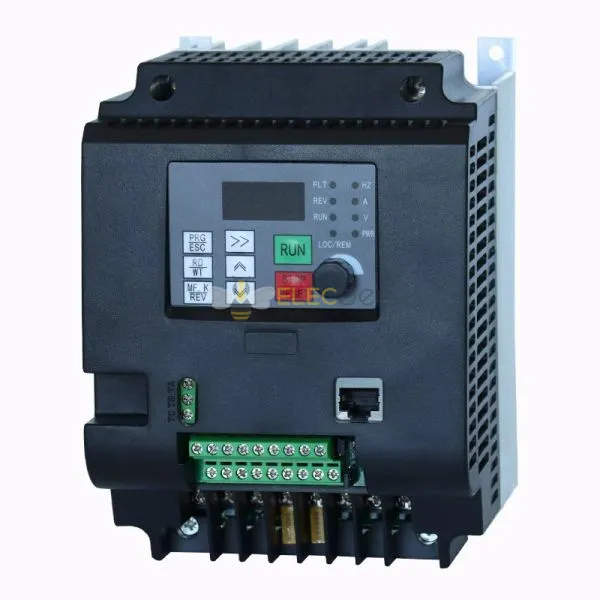
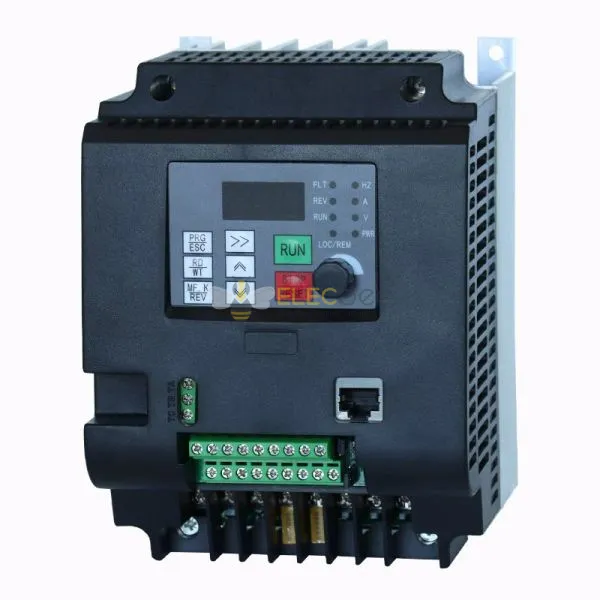
Start by comparing the input, output and current specifications in VFDs & Soft Starters, then use the checklist below to narrow the options.
1. What Is a Single Phase to Three Phase VFD?
How a Variable Frequency Drive Controls a Motor
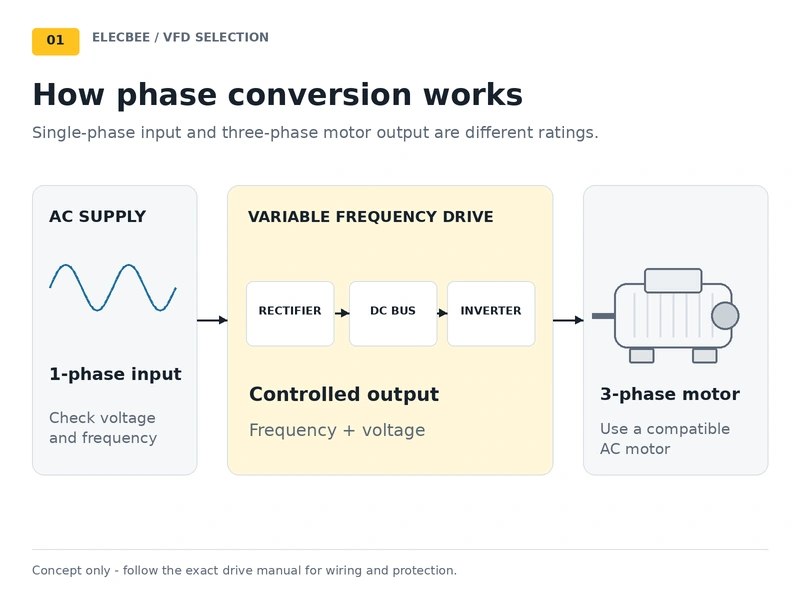
A variable frequency drive converts its incoming supply to a DC bus and uses an inverter stage to produce a controlled three-phase output. By adjusting output frequency and voltage, it controls the operating speed of a compatible AC motor. Depending on the drive and configuration, it can also provide acceleration ramps, motor protection and external control.
These functions make a VFD useful when a single motor needs both phase conversion and adjustable speed. The complete installation still needs appropriate protection, grounding, enclosure design and a motor suitable for the intended operating range.
Single-Phase Input Does Not Mean Single-Phase Motor Output
The phrase “single-phase VFD” can describe the input supply rather than the motor it controls. Read both specifications. A unit marked single-phase input and three-phase output is intended for a compatible three-phase motor.
Do not treat it as a general-purpose single phase motor speed controller for a capacitor-start or other single-phase motor. Specialized drives exist for certain single-phase motor types, but compatibility must be explicitly documented. DC PWM controllers, stepper drivers and AC motor VFDs also serve different motor technologies.
Driving One Motor vs Powering an Entire Machine
A conventional motor VFD's output is intended for its motor circuit. It should not be assumed to provide utility-like three-phase power for a complete machine containing control transformers, heaters, contactors, auxiliary motors or electronics.
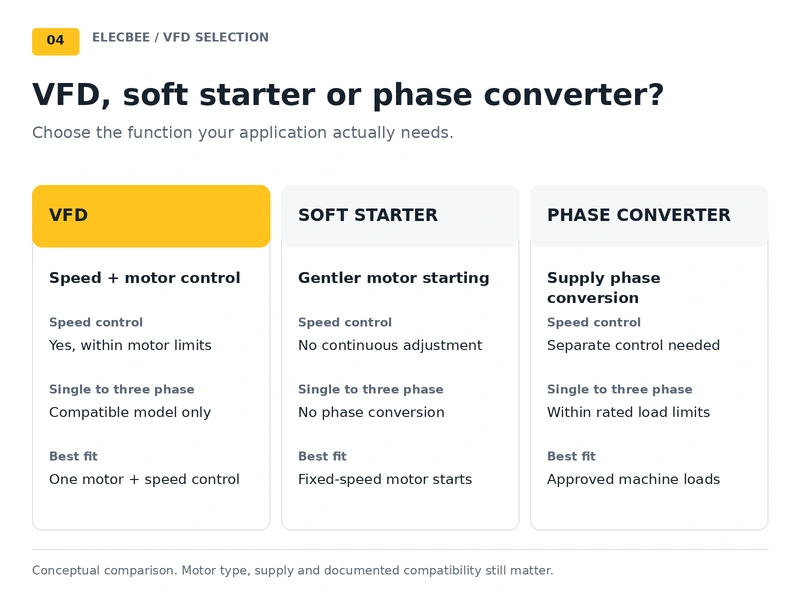
For one motor, a dedicated VFD may be straightforward. For several machines or a machining center with existing internal drives, evaluate a properly specified phase converter or a utility supply upgrade with the machine manufacturer. A soft starter does not convert single-phase power into three-phase power.
2. Match the Supply and Motor Voltage Before Horsepower
Can a 220V VFD Run a 380V Motor?
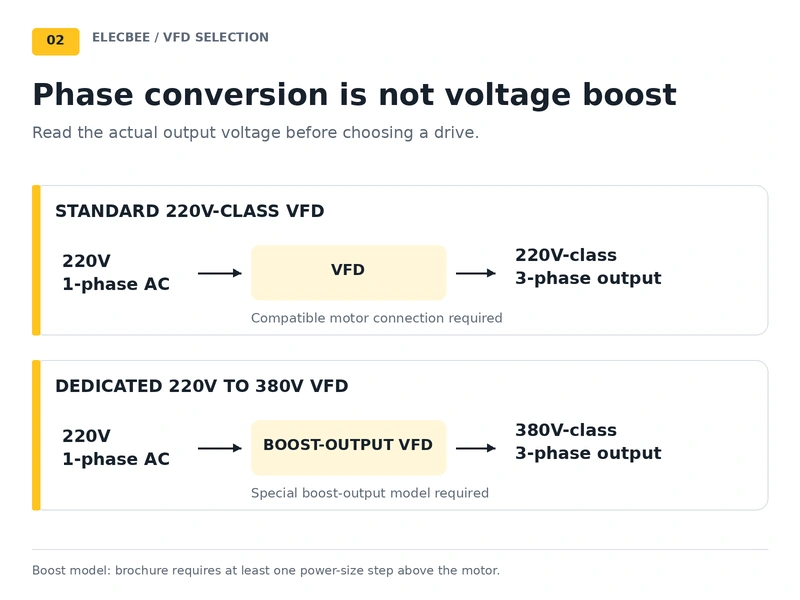
The answer depends on the motor's documented connections and the drive's actual output rating. A typical 220V-class VFD with a 220V-class output does not become a 380V-output drive when a parameter is changed.
A motor marked 220V delta / 380V star may operate from a suitable 220V three-phase output when configured for its documented delta connection. A motor requiring 380V in its available connection needs an appropriate voltage solution. Purpose-built boost-output drives are a separate product type: confirm their stated input range, output voltage, rated current and application limits.
Likewise, do not assume a 220V-input product accepts every 230V or 240V supply, or that a 380V-input product is suitable for a 460V installation. Check the manufacturer's permitted voltage range.
Read Delta, Star and Dual-Voltage Markings Correctly
For a conventional six-terminal IEC motor explicitly marked 230V delta / 400V star, the lower-voltage connection is delta and the higher-voltage connection is star. The nameplate also gives different currents for those connections. Use the current corresponding to the connection you intend to operate.
This example is not a universal wiring diagram. Nine-lead, twelve-lead, two-speed and pole-changing motors can use different arrangements. Identify the motor model and lead markings, and obtain its correct connection diagram. Terminal position and wire color alone are insufficient.
Voltage Compatibility Checklist
| Situation | What to Verify | Buying Mistake to Avoid |
|---|---|---|
| Single-phase supply, three-phase motor | Explicit single-phase input rating and suitable three-phase output | Assuming every three-phase-input VFD accepts single-phase power |
| Motor marked 220V delta / 380V star | Documented connection and rated current at the selected voltage | Using the higher-voltage current to size the lower-voltage installation |
| Motor requires a higher voltage than the drive supplies | Documented boost capability or an engineered alternative | Expecting a software setting to create unavailable output voltage |
| Existing motor is single-phase | Exact motor type and explicit drive compatibility | Confusing a single-phase input rating with single-phase motor support |
3. VFD Sizing: Use Motor Current, Load Duty and Derating
Why Amps Matter More Than the HP Label
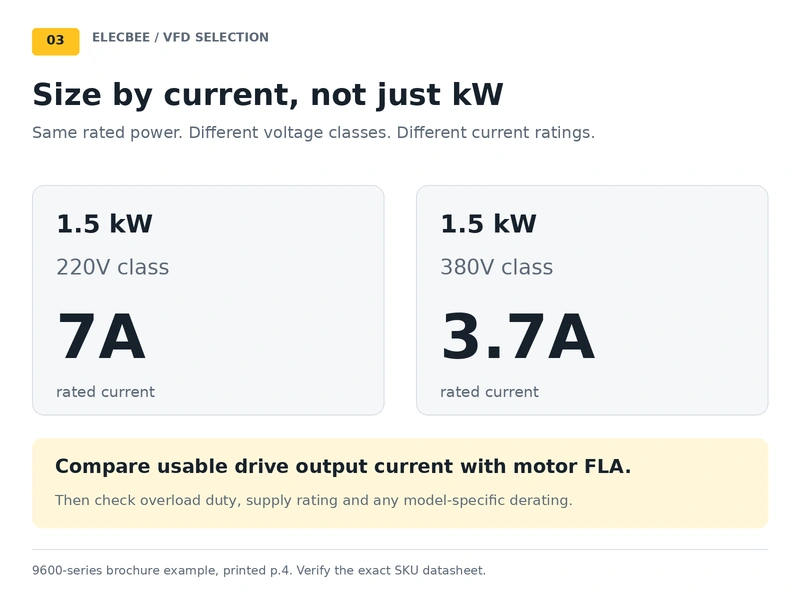
Horsepower and kilowatts help identify a drive family, but motor full-load current is the key electrical selection value. Compare it with the drive's continuous output current for the correct voltage, supply configuration and duty rating.
For illustration, a motor requiring 7A needs at least that much usable continuous output current, plus the overload performance its application requires. An 8A drive is only a candidate if that rating remains valid under the actual installation conditions. Its headline horsepower alone does not prove compatibility.
When Single-Phase Input Derating Applies
A drive designed and rated for single-phase input should be selected from its published single-phase ratings. An additional “double the horsepower” rule should not be imposed automatically.
Some three-phase-input drives permit single-phase operation with reduced output capability. Others do not. Use the exact manufacturer's selection table because rectifier capacity, DC-bus ripple, voltage and other conditions affect the permitted load. Disabling phase-loss protection does not establish approval for single-phase operation.
For a simplified example only, if a manufacturer permits a particular installation at 50% of a drive's 16A output rating, its usable continuous output becomes 8A. The 50% factor is an assumed example, not a universal rule or a specification for an Elecbee model.
Match Overload Capacity and Available Input Power
A drive may have different normal-duty and heavy-duty ratings. Conveyors and machine-tool loads can require substantial torque during acceleration or cutting. Centrifugal pumps and fans often have variable-torque characteristics, while positive-displacement pumps can impose different requirements. Identify the actual load.
Check overload current, permitted duration, starting frequency, ambient temperature, altitude and enclosure conditions. Then check the drive's input-current specification against the available service. Input and motor-output currents are different values. Specify conductors, protective devices and disconnects from the drive documentation and applicable installation requirements.
4. VFD vs Soft Starter vs Phase Converter
Choose According to the Problem You Need to Solve
| Requirement | VFD | Soft Starter | Phase Converter |
|---|---|---|---|
| Adjust speed during operation | Yes, within motor and machine limits | No continuous variable-speed control | Generally no; separate speed control is needed |
| Run a three-phase motor from single-phase service | Yes, with a documented compatible model | No phase conversion | Yes, within its documented load limits |
| Reduce starting shock | Controlled acceleration and motor current | Reduced-voltage starting for compatible motors | Depends on converter and starter arrangement |
| Supply a complete machine or several loads | Do not assume a conventional motor drive is suitable | Motor starting function only | Possible with a suitable converter and machine approval |
Case: A Used Lathe in a Single-Phase Workshop
A recurring workshop question is whether to replace a three-phase lathe motor or add a VFD. Begin with the nameplate and required spindle-speed range. A suitable VFD may retain the existing motor and add speed adjustment, but old insulation, cooling and the machine's control circuit need review.
If the lathe already uses belts or gears, keep their torque multiplication in the decision. Slowing the motor electronically is not mechanically equivalent to selecting a lower gear. A larger drive also does not increase the motor's rated horsepower.
Case: Compressor Startup Makes a Generator Struggle
Another supplied discussion describes a single-phase compressor whose startup causes lights to flicker and the generator to slow. This is a motor-starting and supply-capacity problem, not automatically a phase-conversion problem.
Confirm the motor type, starting arrangement, compressor unloading and generator capability before choosing equipment. A compatible soft starter may address starting current where fixed-speed operation is sufficient. A standard three-phase-output VFD is not a direct replacement for a starter on that single-phase motor. Generator or battery-inverter installations also need approval for the drive's input characteristics.
5. How to Select and Commission a VFD Step by Step
Record the Motor and Application Data
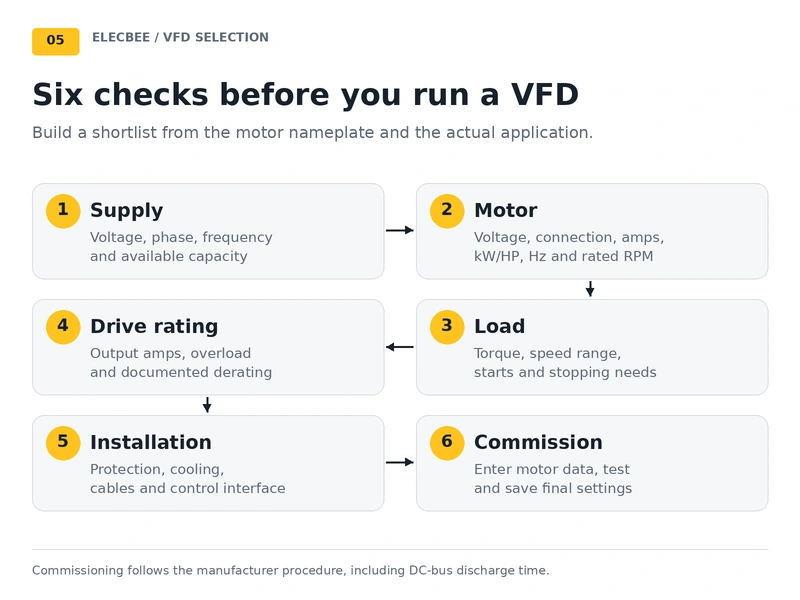
- Identify the supply: Record voltage, phase, frequency and available service capacity.
- Read the motor nameplate: Record motor type, voltage, connection, rated current, kW or HP, frequency and rated RPM.
- Define the load: Note torque demand, operating hours, starts per hour, speed range and stopping requirements.
- Select the electrical rating: Verify input compatibility, output voltage, usable current, overload performance and every applicable derating condition.
- Plan the installation: Specify protection, enclosure, ventilation, cable routing, motor compatibility and control interfaces.
- Commission and document: Enter verified motor data, test under controlled conditions and save the final settings.
For a high-power pump or a machine supplied from a generator, include the process and supply engineers early. A product title cannot resolve system-level power quality or protection requirements.
Enter Motor Data Before the First Run
Factory defaults may suit a different motor. Enter the rated voltage, current, frequency and speed required by the drive, then configure the control mode, acceleration, deceleration and operating limits. Set motor protection for the connected motor rather than leaving it at the larger drive's capacity.
Follow the drive's commissioning procedure for any auto-tune. Some routines rotate the shaft. Establish the required guards and test conditions first. Wiring inspection should be performed with the supply isolated and the DC bus discharged according to the manual.
Plan Controls, Communication and Cable Entry
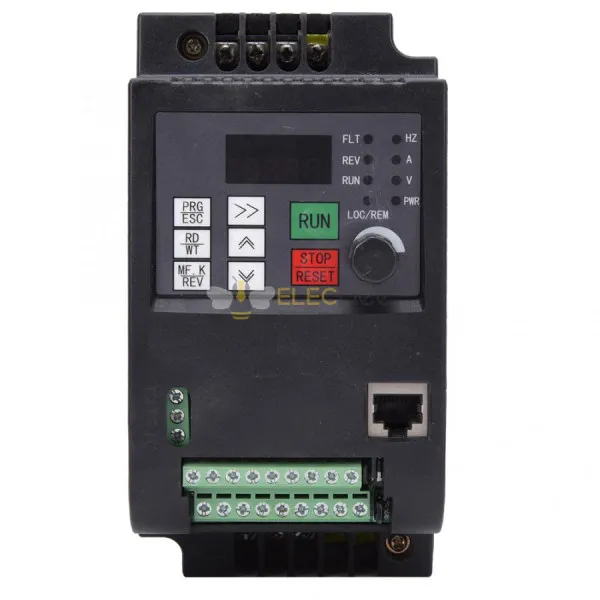
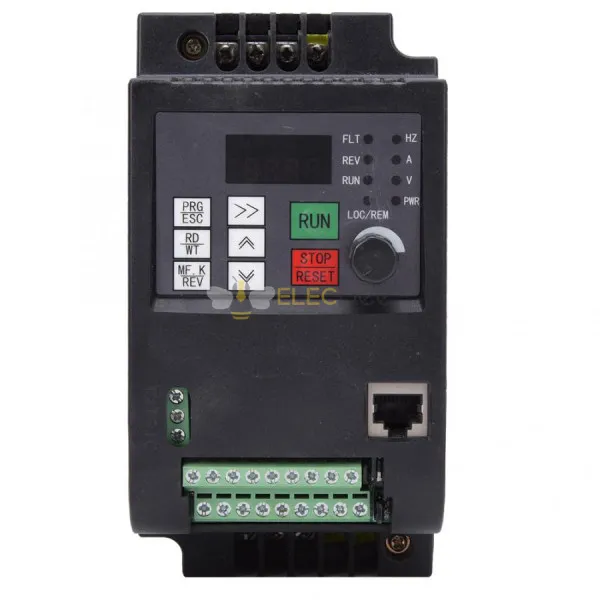
Choose whether commands will come from the keypad, terminal inputs, an analog speed reference or a supported network. Confirm the actual communication protocol and connector pinout. An RJ45 socket does not by itself identify Ethernet, RS485 or a standard pin assignment.
Where the drive supports the required interface, compare RS485 Cable Assemblies & USB to RS485 Adapters. Separate communication wiring from motor-output wiring and follow the drive's EMC instructions. The What Is an RS485 Cable Used For? Wiring & Selection Guide explains bus wiring and termination.
Choose enclosure entries for the cable diameter, retention and required shield bonding. The Cable Gland Size Guide: How to Choose Metric, PG and NPT Glands helps distinguish entry-thread size from cable clamping range.
6. Old Motors, Low-Speed Torque and Common VFD Faults
Can an Old Motor Work with a VFD?
Sometimes, but operating at the nameplate frequency does not remove every compatibility concern. PWM output can stress winding insulation, and installation characteristics can contribute to motor-terminal voltage peaks and bearing currents.
Review motor condition, inverter-duty suitability, cable length and the manufacturer's filter recommendations. A short cable can reduce some reflected-wave concerns, but it does not certify an old motor for inverter service. Thermal insulation class alone also does not establish compatibility. Select input reactors, output reactors, dv/dt filters or sine-wave filters for their documented purpose.
Why Low Speed Does Not Guarantee Full Horsepower
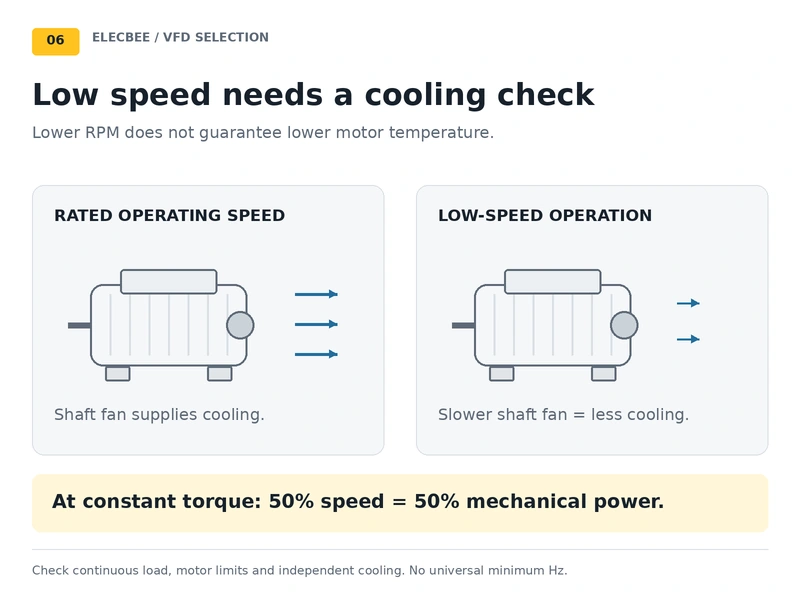
Mechanical power depends on torque and speed. At constant torque, reducing speed reduces available mechanical power. The usable torque range also depends on the motor, control method, current and cooling.
A shaft-mounted cooling fan slows with the motor. Sustained low-speed operation can therefore require reduced load or independent cooling. Keep mechanical reduction where the process needs high torque at a low working speed. Do not use a drive's maximum output frequency as the motor's permitted speed.
Troubleshoot the Symptom Before Changing Protection Settings
In one supplied lathe discussion, the motor behaved erratically and the drive faulted above roughly 20Hz. Participants suggested several explanations, including motor connections, missing output and incorrect settings. The supplied material does not establish a confirmed repair. The useful lesson is to verify the configuration before repeatedly restarting or increasing limits.
| Symptom | Checks to Prioritize | Avoid |
|---|---|---|
| Overcurrent during acceleration | Exact fault code, motor data, connection, load and acceleration settings | Raising current limits without identifying the cause |
| Jerking, humming or unstable rotation | Motor lead identification, connection integrity, control setup and motor/drive condition | Assuming a phase swap repairs an unidentified fault |
| Motor heats at low speed | Cooling, continuous torque demand, current, operating range and motor suitability | Assuming lower RPM always means lower thermal stress |
| DC-bus overvoltage during stopping | Deceleration time, inertia and approved braking arrangement | Adding an arbitrary braking resistor |
| Communication fails when the motor runs | Cable separation, shield bonding, grounding, interface and serial settings | Treating additional retries as a cure for an EMC problem |
Keep the exact fault code and parameter record. Electrical testing must use suitable instruments and the manufacturer's procedure. Disconnect the drive from the motor circuit before insulation testing where the instructions require it. Do not copy terminal jumpers or live-testing shortcuts from an unrelated installation.
7. Single Phase to Three Phase VFD FAQ
Do I Always Need a VFD Twice the Motor's Horsepower?
No. Use the drive's published single-phase rating or its approved single-phase derating table. A purpose-built single-phase-input drive and a derated three-phase-input drive are different selection cases. Motor current, overload duty and installation conditions determine the final choice.
Can I Use a Larger VFD on a Smaller Motor?
Often, within the drive's supported motor range. Confirm that current sensing, motor protection and the selected control mode work with that motor. Program the actual motor data. Excessive oversizing can fall outside the manufacturer's permitted range and does not compensate for a voltage mismatch.
Can a VFD Run Several Motors or the Whole Workshop?
Specialized multi-motor arrangements exist, but they require a documented design, suitable control and individual motor protection. A conventional VFD should not be treated as a general workshop supply. For multiple independently switched machines, evaluate a converter or supply arrangement approved for those loads.
Should I Choose a VFD or a Soft Starter for a Pump?
If the pump needs adjustable flow or pressure through speed control, evaluate a suitable VFD. If it runs at a fixed speed and the issue is starting or stopping stress, evaluate a compatible soft starter. Verify pump type, torque demand, starts per hour and motor compatibility. Energy savings depend on the process and operating profile, so avoid a universal savings percentage.
Before ordering, compare the exact input range, motor connection, usable current, overload rating and control features. Browse VFDs & Soft Starters with the motor nameplate and application checklist available, and request the model's technical documentation whenever a rating is unclear.
Related Guides
- What Is an RS485 Cable Used For? Wiring & Selection Guide
- RS232 vs RS485 vs RS422: Key Differences in Distance, Speed & Wiring
- Cable Gland Size Guide: How to Choose Metric, PG and NPT Glands