0

You may not need a 220V to 380V VFD for a motor described as “380V.” First check whether the motor has a documented 220V delta rating. If it needs 380V at the required operating point, a standard 220V-output drive cannot supply that voltage.
A step-up VFD is a candidate when its specified input matches your supply and its higher-voltage, three-phase output matches the motor. Confirm that you have a three-phase motor before comparing drive sizes. A single-phase input rating on the VFD does not establish compatibility with a single-phase motor.
Does the motor actually need step-up voltage?
Find the motor nameplate, rather than relying on the machine’s supply label or a seller’s description. On a conventional dual-voltage motor, read each voltage together with its Δ (delta) or Y (star) connection. Those pairs determine whether a lower-voltage operating rating is available.
Two “380V motors” can need different outputs

The arrows show voltage choices, not terminal connections. A suitable standard 220V-output drive may serve the documented 220V delta rating; a 380V rating calls for a suitable higher-voltage output or another engineered supply solution.
A confirmed 380V-only motor also requires the higher-voltage route. If the markings are missing or unfamiliar, identify the model and obtain its voltage/connection data first. Lead count or terminal positions alone do not settle the question.
WEG’s motor specification guide, section 3.1.1, describes these dual-voltage arrangements. Two-speed motors and other winding arrangements require their own diagrams. Have a qualified person confirm the connection against the motor’s instructions before moving terminal links or installing the drive.
A voltage setting cannot add a step-up capability
Invertek’s supply guide explains that a typical 230V drive produces approximately 230V three-phase output and distinguishes motors with 230/400V and 400/690V ratings. Use that principle to read the exact drive specification: a normal 220V-output VFD does not become a 380V-output unit because its motor-voltage parameter is changed.
For a step-up model, look for an explicit single-phase input rating and an explicit higher-voltage three-phase output rating. “Single phase to three phase” establishes the phase conversion; it does not, by itself, promise a voltage increase.
Read voltage and current as a pair
The voltage decision changes which nameplate current you use. The motor nameplate example in the SEW-EURODRIVE G..7 catalog, April 2026, page 29 has different currents for its two voltage ratings.
From slash notation to matched ratings
Manufacturer example: G77 DRN132S4/BE11/HR/TF

Field-reading schematic. Source: SEW-EURODRIVE, G..7 catalog (04/2026), p. 29. These ratings apply to the manufacturer’s example motor.
Use your own motor’s current for the intended connection when checking a drive’s output rating. The example’s currents apply only to this motor.
The SEW plate also lists a separate brake rating, Vbr 400 AC. Choosing the motor’s 230V delta connection does not establish how its brake can be supplied or controlled. This is a hoist gearmotor, so its drive selection also depends on the machinery’s control and protection requirements.
Compare the output before the horsepower
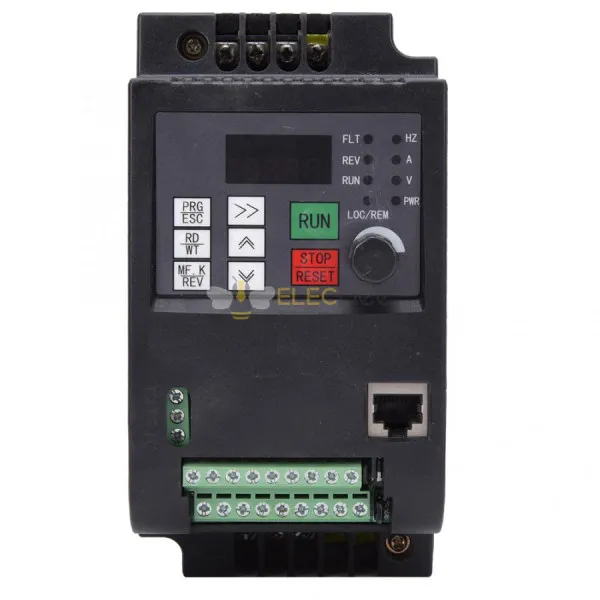
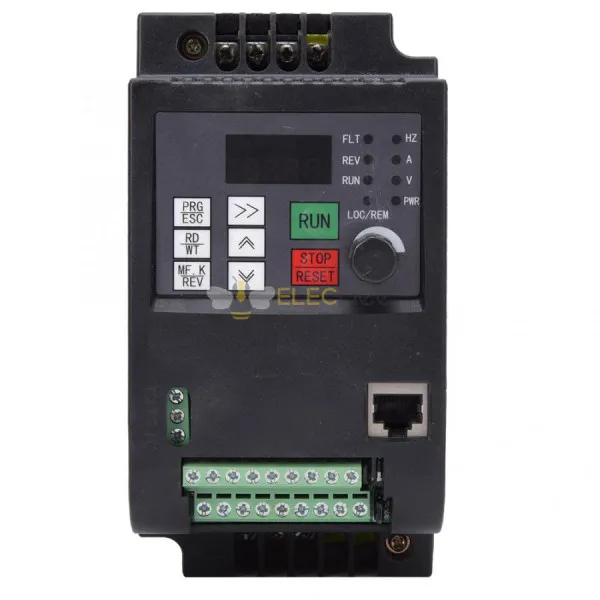
These two Elecbee models share an input voltage and power class. Their output ratings determine which motor-voltage route to investigate. Both are 0.75kW units, not suitable power matches for the 5.5kW motor above.

Before selecting either model, obtain its continuous output-current rating for the intended duty and supply, together with overload and derating limits. A field called “Rated Current” without its operating definition is insufficient for this comparison.
For other power sizes, use Elecbee’s VFDs & Soft Starters category to find the required input/output combination, then open the exact SKU. A family description or a nearby power variant does not establish the rating of the unit you will order.
Finish the checks before ordering
Check the actual supply and output range
A listing marked 220V input and 380V output does not, on its own, establish 230V-to-400V or 240V-to-415V operation. Confirm the drive’s permitted input range and available output against the motor’s required operating point. Also keep frequency with the voltage rating: the 50Hz nameplate example above is not a general 60Hz specification.
Check the load and the supply circuit
Once the voltage route is established, use the motor current for the intended connection and the load’s starting and overload requirements. Ask for the drive’s input-current and supply-protection requirements as well; the motor’s three-phase current is not the figure to copy into the single-phase supply-circuit design. The single-phase to three-phase VFD sizing guide explains the wider current and duty checks.
Separate the motor from the rest of the machine
A three-phase VFD output is intended for its supported motor load. It is not a substitute for a whole machine’s utility supply. Brakes, control transformers, cooling fans and other auxiliaries may have separate power and control requirements, as the brake field in the SEW example illustrates.
To resolve a remaining mismatch, provide the motor’s complete model number, a readable nameplate photo, the intended connection, available supply, driven load and any brake or existing controller details. If the motor’s connection data or the drive’s output rating remains unclear, resolve that specific field before choosing a power size.